“or rabbi” search results (400)

Introduction of Kenyan coffee beans
Kenya is bordered to the north by Ethiopia, the origin of Arabica coffee trees, but it was not until the beginning of the 20th century that coffee cultivation began. In the 19th century, missionaries introduced Arabica trees from the leaves, but did not plant them in large quantities. It was not until 1893 that coffee was cultivated on a large scale because of the introduction of Brazil's ancient bourbon seeds. That is to say, Kenyan coffee is of Brazilian origin, because of water.
2016-06-02 Kenya coffee beans introduction north neighbor rabbi coffee origin lichen
Introduction of Coffee Tree Hope Manor Coffee Flavor and Taste Manor in Arabica, Colombia
Production area: Colombia Popayan harvest time: June to July (90%), October to November (10%) grade: Supremo varieties: Bourbon,Caturra,Typica,Others planting height: 1800 m ~ 2100 m processing method: washing packaging specifications: 70kg/ bag flavor characteristics: Citrus note,Grape fruit,Bakers chocolate,Brown
2016-07-15 Columbia Rabbi Card Coffee Hope Manor Flavor Taste producing area medium
Ethiopian coffee beans, coffee beans
Ethiopia is home to Arabica coffee, and it is in the forests of the Kaffa region that you can see Arabica coffee growing wild. In Ethiopian, coffee is called Bun or Buna, and coffee beans may be translated from Kaffa Bun. Arabica coffee was discovered early in the Harar region, most likely from Karachi.
2014-12-26 boutique coffee beans common sense Ethiopia coffee profile rabbi
Sumatra Manning Arabica coffee beans
One of the most famous and most needed coffee in Asia. The appearance of Mandarin beans is arguably the ugliest, but coffee fans say that the more ugly the Sumatran coffee beans are, the better, mellow and slippery they are. In the 17th century, the Dutch first introduced Arabica saplings to Ceylon (present-day Sri Lanka) and Indonesia. In 1877, a massive disaster struck Indonesia.
2015-07-27 Sumatra Mante rabbi species coffee beans Asia famous demand big
Picking coffee beans planting coffee beans in imported coffee producing areas
Most Arabica coffee beans mature from June to August and Roberts coffee beans from September to October. Therefore, although in some countries where the dry and wet seasons are not obvious, such as Colombia and Kenya, there are two flowering periods a year, that is, two harvests, strictly speaking, only once a year. Of course, the harvest time varies from region to region. South of the equator, such as Brazil
2016-04-16 Coffee beans picking most rabbi coffee beans maturity June-August Rob
Introduction to the flavor and taste characteristics of Arabica coffee manor in Indonesia
West Africa, the origin of coffee grown in Liberia, has a strong adaptability to all kinds of environments, such as high or low temperature, humidity or dryness, except that it is not resistant to leaf rust and its flavor is worse than that of Arabica, so it is only traded or planted in some West African countries (Libya, C ô te d'Ivoire, etc.). Among the coffee in circulation in the world market, about
2016-07-13 Indonesia Rabbi Coffee Manor producing area Flavor palate characteristics introduction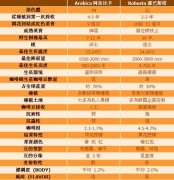
Coffee Variety Comparison Arabica and Robasta Coffee Parameters Comparison
Coffee beans are seeds belonging to the Rubiaceae family, under which there are at least 25 main varieties of Coffee Genus, of which the two most important varieties are Arabica species Coffee arabica (Arabica coffee) and Canafora species Coffee canephora (Robusta coffee), also known as "Robasta coffee". ah
2015-02-16 coffee variety comparison rabbi robas bas parameters coffee beans genus
Ugandan coffee producing regions that produce only small amounts of Arabica beans
Later, when ships replaced sailboats, people drank fresher coffee beans because of shorter delivery times. But people accustomed to old beans are not used to this fresh taste, so they desperately pursue old Java coffee, so that the Indonesian government and some businessmen deliberately store fresh beans in warehouses for one to two years before selling them to consumers. In fact, aged Java beans are more common than fresh beans.
2016-07-02 production small amount rabbi kadou uganda coffee origin flavor presentation later
Classification of coffee varieties which is the best way to grind coffee
Arabica bean coffee tree can be divided into two main varieties: Arabica species (Coffea Arabica) and Robusta species (Coffea Robusta/Coffea Canephora). There are also some minor species, such as the Liberian species (Coffea Liberica) and the Alabasta species (Coffea Arabusta), but they are rare on the market.
2016-06-08 Coffee variety classification grinding which way editing rabbi
Comparison of basic Information of Coffee varieties
Suitable cultivation conditions: Arabica variety (Arabica) is suitable for plateau cultivation, Robesta variety (Robusta) is suitable for lowland cultivation, and Liberian variety (Liberica) is suitable for minimum cultivation. Production: the Arabica variety (Arabica) accounts for about 70-80% of the world's total output; the Robesta variety (Robusta) accounts for about 20-30% of the world's total output of Liberian varieties (Liberica)
2015-02-11 Coffee variety basic information contrast boutique fit cultivation condition rabbi product
Comparison of basic data of Coffee varieties
Suitable cultivation conditions: Arabica variety (Arabica) is suitable for plateau cultivation, Robesta variety (Robusta) is suitable for lowland cultivation, and Liberian variety (Liberica) is suitable for minimum cultivation. Production: the Arabica variety (Arabica) accounts for about 70-80% of the world's total output; the Robesta variety (Robusta) accounts for about 20-30% of the world's total output of Liberian varieties (Liberica)
2015-04-24 Coffee common sense variety basic information comparison suitability cultivation conditions rabbi product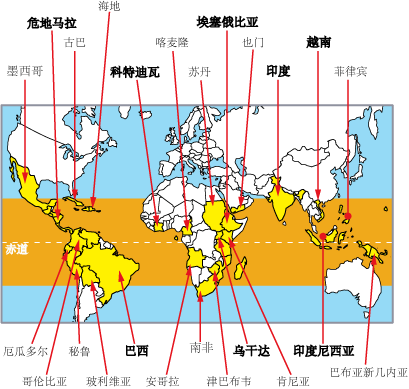
Arabica beans Arabica beans specialty coffee Country of origin Sunya coffee beans Tanzania
Tanzanian Gourmet Coffee has a soft acidity and an attractive aroma, and is an absolute value treat. Tanzania's coffee exports occupy an important position in the overall national economy. Bean berry coffee is produced in large quantities and is said to be stronger than regular coffee. Generally speaking, Tanzanian coffee beans are of exceptional quality. For example, near Kilimanjaro
2016-03-24 Rabbi Coffee Bean Specialty Coffee Country of Origin Nigeria Tanzania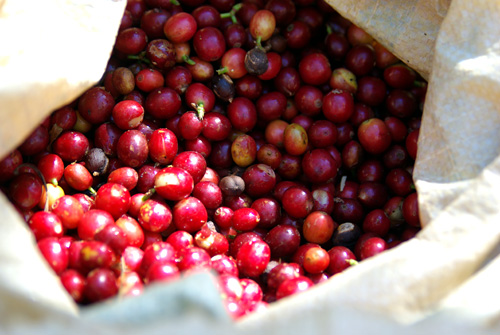
Is it Robusta or Arabica? Coffee bean variety Panamanian love saint manor water wash rose
Global coffee bean tree species are mainly divided into: Arabica and Canephora, of which Arabica coffee beans account for more than 100 coffee varieties of 70%80%coffee. The more common coffee varieties are: Arabica Arabica, with outstanding personality and unique flavor, is the main force of boutique coffee, mainly used in coffee shop management and high-end coffee market supply; Robsta
2016-04-22 Robes Booth or Rabbi Card seed Coffee Bean Variety Panama lover
Introduction of carefully washed Arabica beans and Papua New Coffee
The coffee production in Papua New Guinea is not very high, and its coffee beans are carefully washed Arabica beans. Generally washed coffee beans are full of bright fruit aromas, but do not have a strong acidity. It is characterized by a silky soft taste and excellent aroma, moderate acidity, and is a relatively rare variety of high-alcohol and medium-acidity coffee, regardless of
2016-06-29 After careful treatment washing rabbi Kadou Babu Ashin Guineas coffee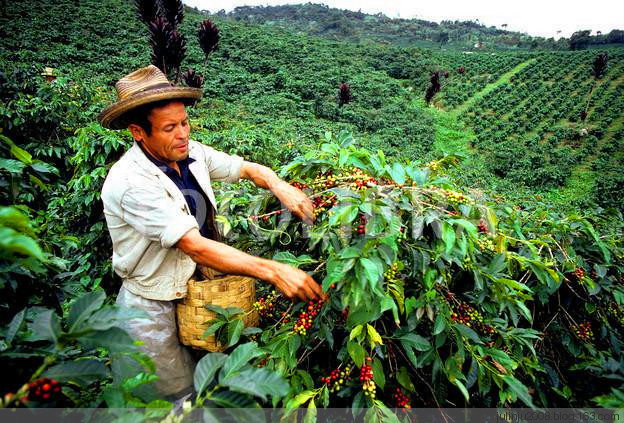
Costa Rican coffee varieties of Costa Rican Arabica beans
Costa Rican coffee has full particles, ideal acidity and unique strong flavor. Costa Rica's coffee industry, originally controlled by the Costa Rican Coffee Industry Company (InstitutodelCafdeCostaRica, ICAFE), has been taken over by the official Coffee Committee (OficinadelCaf). In exported coffee, those products that are considered to be of substandard quality are used in blue.
2016-03-21 Costa Rica coffee variety rabbi Kadou granules
Kaha Yang Gan Manor Coffee Manor in Indonesia Kopi Luwak
Arabica coffee beans grow in tropical colder high-altitude areas, and the hot and humid zone that is not suitable for Arabica coffee is where robusta coffee grows. Robusta has a unique aroma (called Rob smell, which some people think is musty) and bitter, accounting for only 2% of mixed coffee. 3% of mixed coffee, the whole cup of coffee becomes Robusta flavor. Its flavor
2016-07-14 Indonesia Kaha Yanggan Manor Coffee producing area introduction Cat shit Rabbi Card species
Relationship between Arabica coffee bean family members hematemesis and sorting out Arabica coffee bean family relationship
Coffee beans come from two main types of coffee trees: Robusta and Arabica. Drinks with high caffeine will come from Robusta, Coffea canephora robusta variety and Elaraby plus coffee beans (Coffea arabica) are commonly used by general coffee bean manufacturers, and the taste of the two coffee beans will be different with different proportions.
2016-04-30 Rabbi coffee beans family members relationships hematemesis finishing from coffee
Roasting caffeine Maillard reaction and caramelization of Arabica and Robusta beans
Boutique coffee is fresh coffee. Whether it's food or drink, of course, the fresh the better, and so is boutique coffee. High-quality coffee should keep the coffee beans fresh before making, including the preservation of baked beans, and grind the coffee beans into powder before making, which is also to retain its original and best flavor. And the way of making hand-made coffee is such a way to make high-quality coffee.
2016-06-27 Rabbi Robes Booth Bean growing roasting caffeine Rudd response Saccharification Anti-
Yemeni Coffee-the vanishing Arab Wild
Although Ethiopia is the birthplace of Arabica, the first coffee that Europeans drank from the end of the 17th century to the beginning of the 18th century came from Yemen. At that time, all African or Arabian coffee was exported from the port of Mocha, so that Mocha became synonymous with coffee, while Harald, the capital of the city walls, became a supporting role. However, three hundred years later, Yemeni coffee is no longer what it used to be.
2015-10-22 Yemen coffee vanishing medium Arab wild Ethiopia though rabbi
Arabica Coffee Bean "Mist"
There are probably a lot of consumers out there who think that coffee made with 100% Arabica beans is better than coffee made with Arabica beans mixed with Robusta beans, and it's not just them, it's even me, and I used to think so. In fact, we're all wrong. There's no constant law in the coffee world that says Arabica beans are better than coffee beans.
2014-08-11 rabbi coffee beans fog now there may be many consumers think choose